Tuesday, December 21, 2021

5 Ways You Can Get Better In Babble Royale Right Now

I've been playing Babble Royale a lot the past few days, because I was engineered in a lab to love this game. I'm not the best player in the world by any means, but I have cracked the MMR and Total Wins leaderboards a few times, and I'm currently rocking a 38% first place rate (that's 6 times the expected 1-in-16). What's more, while I'm a casual Scrabble player, I haven't sat around memorizing dictionaries-- most of my wins come from what I think are good, solid fundamentals. What I'm getting at is that this "strategy guide" doesn't come from thin air.

Probably the best way to improve at the game would be to play it a bunch, memorize which two-letter words it allows, learn common "hooks" that allow you to latch onto words, and so on. I can't write much about that, though. I can write about the next-best thing, though: Here are five ways you can get better in Babble Royale, right now.

(The obvious disclaimer applies: I'm just a girl on the internet; these tips will only make you behave more like me, because that's what I know how to write; they might conflict with the advice of other good players or even better players, et cetera.)

1. Pre-place your kill words before bombing

This is an easy one. You know when you're in this position:

Since you're a super genius you see you have a kill if you use a bomb, then play ADOBE / WE.. Well, you don't have to bomb, then type the letters OBE like a doofus. In a situation like this, you can pre-place the letters OBE, then quickly press 1 (or whatever number your bomb is in) plus SPACE.

This is such a small thing, but it's a huge advantage. Babble Royale is a game where, for the most part, if you can eliminate your opponent, they can eliminate you (more on that later). Giving them no time to counterattack is a way of breaking this symmetry.

2. Value multipliers highly

Look, most of this game is not about the points. My focus in this game is about what area I'm controlling, and if the Q I'm treating as a shield wall lines up on a point multiplier, it's not my doing. That being said, I've noticed that I prioritize dropping near big multipliers more than other people. I do this because doing so gets you money, which can be exchanged for goods and services, as the meme goes. An early AX or ZA on a high multiplier, or even an early HA or PA, can get you money right away, and you basically paid no opportunity cost.


You should still value early S and bomb powerups-- S tiles and bombs win games. Just consider whether you need that S now or could manage with it later.

3. Have a plan for the more meddlesome letters

Babble Royale gives you a lot of credit for frequently emptying your hand. Especially in the beginning of the game, my goal is to throw my tiles on the board as quickly as I can in a mad rush for powerups and money. J, X, and Q are obstacles to this-- if left unchecked, they threaten to reduce your virtual maximum hand size AND turn off your ability to refresh your rack by hitting zero tiles. That's why I actively think about how to get rid of my big-girl letters when I draw them. Poor Q, for example, only has a handful of realistic ways to get rid of it: QI, QUA, SUQ, or some other Scrabbly endeavor, so I'm not going to lay down my I willy-nilly.


This goes double for C and V, the antagonists of Babble Royale. In the current dictionary, there are no valid two-letter words that contain a C or V. As a result, when you draw a C or V, Babble Royale becomes an RPG, and they are your first side quest. If your last two letters are V and E, instead of impulsively dropping your last E wherever you can, maybe save it. You might be able to make VIE, VEE, EVE, or AVE-- and if not, you weren't going anywhere. Conserve your ability to make plays until you have more information-- to put it more bluntly, wait and give yourself the opportunity to draw out of your situation.


Other valid plans include "recycle" and "overload". Often if I have two big-girl letters that don't mesh nicely with each other, like C and J, I'll plan on overloading. (Free bonus tip: Try to overload right before you're about to get a new tile-- it makes you a juicy target for less time.)

4. Readjust your vowel priorities

Not all vowels are created equal.


E is god-tier. Silent E in particular does so much work in this game. You can kill people from a surprising distance by tacking an E on their word; you can tack an E your word and get out of a clumped area without bombing; you can play JA on your HAT and then extend your HAT to HATE, getting rid of that J while making your escape. Non-silent Es are nuts, too-- it's just a common letter. Additionally, EE is basically everywhere, and a word on its own in the current dictionary. What I'm getting at is that it's very difficult to have too many E's.


A and O also get an A-grade. They're common vowels, and they're good outlets for your trickier consonants (AX, OX, JA, JO, ZA, and ZO, to name a few). Again, it's hard to have too many of them-- OOs are all over the three- and four-letter words, and you can always chain AAs or OOs if you find yourself flush with them.


I is a good letter, too-- better Scrabble pros might recognize it from the famous ripe-for-bingos rack AEINRST. That being said, it's easy to amass three or four I's and not have space to get rid of them. I basically always want one, and I usually value the first I over the first O. But if I have multiple O and I tiles, all else being equal, I'm wont to play DIN over DON, for example. In fact, I often find myself aggressively getting rid of Is and still having enough.


U gets the short end of the stick. It's usable, but it does not have the broad appeal of E. I want between zero and one most of the time, and will play my tiles accordingly. I will almost always play DUN over DIN or DON or DEN.


TLDR: In a vacuum, try to have multiple Es, As, and Os, in about that order; try to have one I; try to ditch U.

5. Ask who has the bomb privilege

Bombs are good. One of the ways to win in Babble Royale is to exploit the bomb's range to make your bombs good against your opponent, and bad against you.

Let me show you what I mean. Remember this situation?
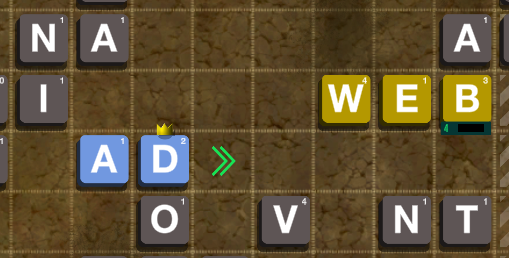
Let's say both of you have OBE and a bomb in hand. Which one of you can get the kill? Well, the bomb's radius is a 5x5 square with the corners cut off:
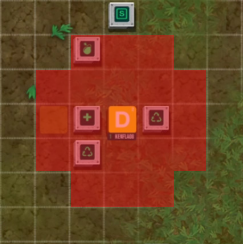
, so in this case you can both bomb to destroy the V, then play OBE (pre-placing your letters, of course). So the kill goes to whoever notices faster.

Now let's say you're blue in this situation, and both of you have RIS for ARISE or ARISES. Who gets the kill?

In this case, red can't blow up the T blocking ARISE, but blue can bomb the T and play ARISES. This means that red has to either draw another word (they can bomb to play ATONE or ATHLETE) or skeedaddle.

As people get better at the game, identifying who has the privilege of bombing productively will only get more important. When you and your opponents both know the three-letter words, if you’ve both played to develop good racks, the only difference between you is your position in space. Being able to identify whether your position in space is defensible is really important.


Monday, September 20, 2021

The Best-Designed Pokemon Card

The best-designed Pokemon card of all time is named "batman!!". It has 1000 HP, the PokeBody "batcave" that means it can't be killed, and the PokePower "batereng" that reads "kills any pokemon on the other team".

Its medium is marker on construction paper. It was not sold or bought or copyrighted or kept hidden. It advances no claims about art or about Pokemon cards on purpose.

Great art creates a critical response. The card batman!! can be stopped by "me" who has HP infinity, the attack "gun" that does infinity damage, and "when this is killed by a pokepower return it to the bench and you can put that card on the bottom of your enemys deck". Reportedly, Emma (the artist behind batman!!) cried when she realized that batman!! was not immune to being put on the bottom of the deck.

Emma made card games of her own as she grew older. The first expansion of Fight Cards had ten cards, each on an index card. You got one energy per turn, because she didn't want to write "energy" on a bunch of index cards. Her second expansion had seven cards, and was widely considered by her contemporary and younger brother Taric to be "overpowered because you just made my cards but stronger". It was the best card game of all time because whenever she and her brother agreed it was solved, they added new cards.

When Emma was growing up, strong basic Pokemon had 100 HP. Years later, they have up to 300. How quaint compared to batman!! and me! The ends of the artistic institution of Pokemon cards are stripped bare. They grow stronger over time, making each other obsolete, and if you are naive this is their end. This cannot be so, though, because Emma's batman!! can beat even her friend Jessica's unfair Magmortar deck built from sanctioned booster packs.

Jessica would go on to author a number of critical responses, such as ANTIBATMAN RAY and FIRESTAR. This, if anything, is the desired effect of the normative force exerted by Emma's art. This is the secret to why batman!! is a better Pokemon card than even Roseanne's Research, the best Pokemon card you can play in a tournament. batman!! begets critical responses; Roseanne's shoos them away if they are not made by The Pokemon Company.

It's not wrong, exactly, to say that "real" Pokemon cards are made in pursuit of capital-- actually, it's perfectly right to say so. But that undersells the force that makes them. Years ago, artists sorted time by real numbers to organize the card artists, sorted space by longitude and latitude to ease the movement of booster packs, sorted an incommensurable amassment of players by which kinds of cards were made for them, sorted stories by trope to further the development of resonant loglines. And from this blood sacrifice art, of a certain definition, was born.

A Pokemon card, like Bulbasaur, is a temple to this worldless timespace. Its true purpose is to sway us into believing that those artists were right to sort time and space and people and stories. Emma's batman!! was made between dinner and bedtime, in her room, for Taric and Jessica, about Batman, and she hasn't even read Marx yet. Nine-year-olds often have such adept critical responses.

Friday, September 10, 2021

Faith

What is faith?

the Magic card Faithless Looting. It is a sorcery that costs R and says "Draw two cards, then discard two cards". It has Flashback 2R. Its flavor text is "Avacyn has abandoned us! We have nothing left except what we can take!" Its card art depicts two figures destroying a church.  

Faith is the belief in an unfalsifiable claim, something you accept knowing that you can't prove it false with whatever method of proof is most natural. It's most commonly used in a religious context-- if you have faith in a god, you interact with them as if you have proven that god is real, while being comfortable with the idea that such a proof cannot exist. But faith is not exclusive to religion. Mathematics, for example, requires faith-- mathematical proofs are all rooted in axioms like "all right angles are the same" or "every natural number has exactly one number right after it".1 All worldviews, scientific, literary, religious, or otherwise, are built on a core belief that seems obvious, but can't be proven with the same tools provided by the worldview. This isn't a bad thing-- it's merely a fact of how worldviews work. 

This is why the “faithlessness” in Faithless Looting is red. If you don't have faith in anything, it's hard to apply any sort of method (scientific, critical, or otherwise) that builds from base principles. Red is the common enemy of blue and white, the colors most disposed toward method, so it follows that faithlessness is red.

Let's examine the card text. At first glance, "Draw two cards, then discard two cards" only mimics the the art, mirroring a process of destruction. After casting Looting, the player has two additional cards in the graveyard and (if they didn't use its Flashback ability) one fewer card in hand. However, what if we view a card not just as "material", but as a fact or a belief? After all, if a strategy is an argument about the game2, then a card is a link in the chain of logic you're using to prove that argument. In this case, Faithless Looting models the process of throwing out old facts and acquiring new ones. Notice also that the "facts" that remain in hand replace the old ones, rather than building upon them; Faithless Looting does not privilege the existing worldview over the potential one. (If anything, the fact that you're casting Looting means you want to throw out the old cards in your hand in favor of something else!) Under this reading, every time you cast Faithless Looting, you are literally reassessing the core beliefs about how you're going to win the game, and thus reassessing your faith in the bomb rare in your opening hand.

Hilariously, our interpretation of the card text clashes with how the card tends to be played. We imagined the post-Looting player as having just reassessed their plan, probably down material, graveyard filled with shattered beliefs about what the game was going to look like. But historically, Faithless Looting has accomplished the opposite. The deckbuilder has a very clear idea of what should happen when they cast Looting-- discard extra lands or cards that like being in the graveyard like Arclight Phoenix, and draw two new cards. In this situation, the player gains material in any sense that isn't "how much literal cardboard is immediately in front of me". More importantly, though, while the player may have to face tough choices about what to discard in some situations, the deckbuilder does not get the sense that Looting will be played as an anti-methodical rewriting of the hand. If anything, Looting is a tool that confirms which facts go into the graveyard and which stay in hand.

None of this is to say that Faithless Looting is unfun or skill-light. (There are lots of factors at hand-- I'll leave sticky situations like "discarding a spell instead of a Phoenix to play around Rest In Peace" to you.) But if Faithless Looting artistically represents the process of reforging the links in the chain of your worldview, it's beautifully dissonant that it is one of the most steadfast of links.